
The Indian government has introduced the Jan Vishwas (Amendment of Provisions) Bill, 2026, in the Lok Sabha to decriminalise and rationalise minor offences, aiming to promote ease of doing business and living.
The government has introduced a bill in the Lok Sabha to amend provisions for decriminalising minor offences, aiming to promote ease of doing business and living.

Trinamool Congress MP Nadimul Haque criticised the Jan Vishwas (Amendment and Provisions) Bill, 2026, in the Rajya Sabha, questioning the government's approach to amending multiple central laws through a single piece of legislation and raising concerns about its impact on public health and federal funds owed to West Bengal.

Union Minister Annpurna Devi hails the passage of the Jan Vishwas (Amendment of Provisions) Bill, 2026, as a significant step towards trust-based governance, simplifying laws, and improving the business environment in India.
The Jan Vishwas (Amendment of Provisions) Bill, 2026, has been passed by the Indian Parliament, decriminalising minor offences across 79 central laws to improve the business environment and reduce harassment. Ministers highlight the bill's role in promoting trust-based governance and ease of doing business.
The Jan Vishwas (Amendment of Provisions) Bill 2025, aimed at decriminalizing minor offenses to promote ease of living and business, was introduced in the Lok Sabha and referred to a Select Committee.

Parliamentary Affairs Minister Kiren Rijiju indicated that the government may bring a bill to increase seats in the Lok Sabha, potentially to implement reservation for women in the legislature. The Opposition has raised concerns about the timing and implications of the proposed bills.

Lok Sabha proceedings were adjourned for the day on Thursday after passage of two bills amid continuous protests by opposition members over the violence in Manipur.
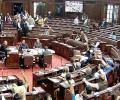
The government on Thursday listed bills on personal data protection, to amend forest conservation laws and on the contentious ordinance on Delhi services for the monsoon session of Parliament beginning next week.
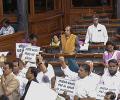
The monsoon session of Parliament which saw many disruptions since it began on July 20 over the Manipur violence issue, is set to become more turbulent with the government likely to introduce a bill in the Lok Sabha to replace the Delhi services ordinance.

The productivity of the Budget session was abysmal. The Lok Sabha functioned for 33% of its scheduled time (46 hours); the Rajya Sabha 24% (32 hours).

Parliamentary Affairs Minister Prahlad Joshi has said that 31 bills will be taken up in the monsoon session. Among these include the Digital Personal Data Protection Bill, 2023.

Fondly remembering the contribution of retiring members from the Rajya Sabha, Chairman Jagdeep Dhankhar on Thursday said the wisdom shared by them would be greatly missed and their departure would leave a void.

The situation in Manipur and the Delhi services ordinance are set to dominate the Monsoon session of Parliament beginning Thursday with the Opposition gearing up to raise these issues to corner the government.

The Modi government's flagship initiative 'Make in India' launched 10 years ago has helped the country boost exports, push investments and promote manufacturing. Under the initiative, launched on September 25, 2014, a series of measures have been taken by the government to boost local manufacturing. These initiatives include the rollout of production linked incentive (PLI) schemes for 14 sectors, easing foreign direct investment (FDI) norms, reducing compliance burden to improve business climate, all approvals through single window, and rolling out of the national logistics policy.
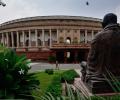
Over the last 50 years, the number of sittings of Parliament has been declining and has halved since the 1950s and the 1960s, the report stated.

Debt mutual funds are likely to be stripped of the long-term tax benefit if they invest less than 35 per cent of their assets in equities. Such mutual funds will attract short term capital gains tax. The government is likely to make such a proposal in the form of an amendment to the Finance Bill 2023 in the Parliament, sources said.
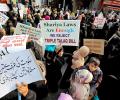
The bill will replace an ordinance issued in February by the previous Bharatiya Janata Party-led National Democratic Alliance government.

The law minister said 20 Muslim countries in the world, including Pakistan and Malaysia, have banned the triple talaq. "Why can't a secular India do it?" he asked.

Rajya Sabha also rejected an opposition sponsored motions to send the bill to a select committee of the House and for making triple talaq a civil offence with 100 votes against it as compared to 84 in favour.

BJP would observe the next 10 days -- from Sunday to September 17, the birthday of the PM -- as 'seva parva'.

Sangh affiliates believe the government's apparent anti-poor message led to their loss

True, Azam Khan is being targeted rather disproportionately and also because of his Muslim identity. That must be protested and resisted. But to say that he is a big messiah, and his profit-making educational enterprise is an issue concerning all Muslims of India, is absolutely unjustified, assert Mohammad Sajjad and Md Mohammad Zeeshan Ahmad.

Here's the full text of President Ram Nath Kovind's customary address to the joining sitting of Parliament on the first day of the budget session.
